

Interview with Dr. Mary Xu
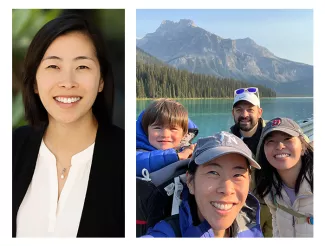
Interview with Dr. Mary Xu by medical student Esther Chai.
Dr. Xu is a head and neck microvascular surgeon practicing within the Department of Otolaryngology. Her research focuses on head and neck cancer care in resource-limited healthcare settings, spanning both domestic and international contexts. She maintains ongoing partnerships with healthcare institutions in Tanzania and Rwanda.
Esther: What was your surgical training like, and how did you choose ENT—particularly microvascular surgery within it?
Dr. Xu: I went into med school planning on becoming a medical oncologist and never really thought about surgery at all. No one in my family was a surgeon, and I couldn't even really see myself as a surgeon.
But during my med school rotations, I really fell in love with the operating room and surgery. In the OR, a day could go by, and it felt like an hour. I just loved working with my hands.
I was really surprised that I liked surgery and was drawn to the hands on, intricate nature of it, and just how vulnerable patients are in that relationship. I have always really been interested in cancer care, so I was exploring different types of surgical fields that would allow me to take care of cancer patients.
I was also very much drawn to the artistry of surgery as well. I considered plastic surgery and general surgery, but ultimately found otolaryngology partly because it was one of the surgical subspecialties that you could be the doctor taking out the cancer and then also the doctor reconstructing the cancer at the same time.
So ultimately that's what drew me to otolaryngology — being a surgical oncologist, where I could take out a cancer, do the reconstruction, and have that longitudinal relationship with patients through their journey. So that's my roundabout journey of how I unexpectedly became an otolaryngology doctor.
Esther: Can you share who or what experiences have made the biggest impact on your path to surgery or just general medical training?
Dr. Xu: I think like many things in life, some things are just very random or kind of unexpected. I think for me, in medical school, I was in a training program where some of the prior trainees ended up in ENT, and so I just crossed paths with them during my med school rotations. They encouraged me to look into ENT and really consider this field.
I did a gap year where my focus was actually on pediatric oncology, but when I came back, I thought to check out surgery. I ended up doing a rotation, and I was really drawn to the group of people, "nerdy and nice." Like I mentioned before, I also really liked the aspect of being both a cancer doctor and reconstructive one as well.
Those are probably the biggest influences that drew me to the field. I wouldn't say it was necessarily one person, but all the interactions together along with the people and field are what ultimately drew me to ENT.
Esther: Could you talk about what mentorship looked like for you during your training?
Dr. Xu: I have been very fortunate to have numerous mentors across different fields, institutions, and stages of my career; I have been very fortunate for all the guidance and support. Like many other things, it sometimes can come out of very organic relationships or interactions where you connect well with mentors. I've had many mentors through medical school, residency, fellowship, and now I seek mentorship as faculty. One thing that kind of struck me, going from a trainee to even a faculty seeking mentorship is how proactive you need to be in that mentorship relationship. When I was a trainee, I would see junior faculty reaching out, asking for help, scheduling meetings with senior faculty on a regular basis to touch base and even get big picture career advice. Coming to these meetings with an agenda or questions that I want to discuss is key and that's been really helpful.
The other piece that comes to mind is that the mentor mentee relationship can go both ways. I learn a lot from my mentees — they bring new ideas in different areas. I think that relationship can definitely go both ways and can be enriching for both.
Esther: Yeah, that's amazing. I know you've done incredible work in global surgery with the otolaryngology initiative in Rwanda. Where did you see the opportunity and gaps that were presented to you? How did you take action and step into that?
Dr. Xu: I've had a long-standing interest in cancer care and also in global health. As a child of immigrants, I've always had this global interest and perspective, and wanted to maximize the opportunities I had as much as possible.
I was in medical school, at a time when global oncology became a much more developed field. I think previously people had the concept that global health is more associated with infectious diseases, maternal health, and child health. I was fortunate enough to be at a time where discussions around global oncology were starting to kick off.
I'd always wanted to learn and get a better international perspective, so I was fortunate enough to do a gap year in Rwanda at a place called the Butaro Cancer Center. I helped collect data and got to shadow on wards, with a focus on pediatric oncology care.
During that year, it was really interesting for me to see that even as a trainee, you have a lot. You may not have a lot of skills necessarily, but the one thing that's super valuable, is your time. The clinicians are super busy, but as a student, I could go through these paper charts for hours on end, collect data to inform treatment approaches at a hospital level and even at a national level.
That gap year just reiterated the need that there's so much need worldwide. There are many disparities in cancer care nationally, and the need globally is also incredible as well. That year was the first step into global health work and research.
During this time, the Lancet Commission on Global Surgery was first launched. This was one of the first major reports that evaluated surgery from a global health standpoint with this public health lens. It put into perspective that out of 7 billion people, around 5 billion people in the world don't have access to safe, affordable, and timely surgery.
From there, within the field of ENT I started meeting people who were also interested in global surgery. Through mentors and colleagues, I became involved with and supported collaborations in Tanzania through the UCSF Global Cancer Program, Rwanda through the University of Global Health Equity, and co-founded an international research group the Global Otolaryngology-Head and Neck Surgery Initiative. I think these experiences were part luck–being at the right place and right time– and part perhaps continuing to seek collaboration with people sharing values and interests.
Esther: Wow. That's amazing. It's cool to see how one thing could lead to another and the breadth of impact you're able to have expanding from there. You talked about seeing firsthand that the need for surgery exists, locally in Rwanda and then even globally. Could you speak more to that? Was this coming from mainly from an educational, surgical capacity, or research perspective?
Dr. Xu: That's a great question. I would say all the above. I would say that there's definitely needs in the different buckets.
Globally within ENT there's an average of like two ENTs per 100,000 population. But in some parts of the world, like in sub-Saharan Africa, it's 50-fold less than in parts of Europe. So there's clearly a clinical need — a real dearth of subspecialist surgeons in parts of the world.
Within that, there's also an opportunity for bidirectional capacity building — enhancing skills and sharing knowledge around the world. Going to Tanzania, for example, I saw surgeons operate there and picked up things I brought back to ZSFG and to how I think about patient care here. So it goes both ways.
And then there's research. I think research on a global level is really critical, because things get funded when you can show there's a need, and you need research to do that. Research helps quantify and show a clear picture of what's going on, both for clinicians and teams trying to improve care.
From a health policy standpoint, you also need those numbers to push for funding, whether through grants, foundations, or national public health support. We're lucky here at UCSF because we have access to funding opportunities, mentorship, and a robust global health community, but that infrastructure isn't always there in other institutions. For instance, UCSF covers article processing fees, which in some other countries would equal a clinician's entire monthly income.
So the needs really span the clinical, capacity-building, and research sides — everything, basically.
Esther: Wow, there's really work that can to be done at each entry point. Could you talk about some of the main challenges you faced during your time in Rwanda or Tanzania, doing global surgery work? And what do the next steps look like now?
Dr. Xu: I'd say there are challenges on a couple of levels. One is at the career-level: there's growing interest in global health, but building a career in it and getting the resources you need is hard.
In ENT specifically, there are probably only a handful of people doing global health work academically so it always takes work to pave a new path. So what I tell mentees now is: think outside your institution. Build your own mentorship team, look for resources, projects, and funding beyond where you are — piece together the support you need. That's especially true now, with national policy changes affecting funding priorities between national and global health work.
On a project level, there's a Swahili saying — pole, pole — "slowly, slowly." Global health work takes time. Our IRB approvals alone can take over a year. Globally, I'm a guest in other people's health systems, so I follow the lead of my collaborators. Things work differently in different parts of the world, relationship-building matters a lot, especially in certain cultures, and things often just take longer. It has its own timeline, and you learn to go along with it. It's taught me to be really flexible — in a good way.
Esther: I think it's exciting that people keep moving forward despite those barriers. Even as someone hoping to work in global health myself, I've gotten similar advice — that you have to be okay with things not going according to plan, but stick with it anyway. Do you have any other advice for how students can develop their interests in global health?
Dr. Xu: Yeah, it's a good skill to learn. It's helped me as a surgeon too, since things don't always run on your timeline. Global health has reinforced that for me.
One of my mentors, Dr. David Shaye, told me that if you're interested in global health, it doesn't matter what you choose. Everything is needed. There's a place for every specialty in the global health world.
And building on what you said about capacity building — my understanding of it has really expanded over the past five or ten years. In ENT, there are the obvious efforts, like training ENT surgeons. Additionally, there is capacity building among other healthcare providers as well. Our group of collaborators in Rwanda developed a simulation-based medical school curriculum, and one ENT Dr. Gratien said, "why don't we teach this to primary care providers too?" So now the team is training PCPs in ENT-related procedures and topics.
In a world where there aren't enough surgical subspecialists — or even surgeons — it's worth thinking about capacity building across the whole workforce, including primary care. In many countries, most people without access to an ENT will end up seeing a primary care provider for ENT issues — earwax removal, nosebleeds, things like that. So capacity building can go beyond surgeon-to-surgeon work.
Esther: That really expands the perspective on what capacity building can mean — beyond surgery, to health systems improvement more broadly. Thank you for talking through all of that. I have one final question, if that's okay. Surgery is a demanding field, and it sounds like it requires a lot of flexibility — I imagine that extends to your personal life too. How have you balanced family, relationships, and friendships alongside this career?
Dr. Xu: I think, as is probably true in life generally, it comes down to finding supportive people around you. I'm very grateful to my husband, who's been supportive not just of my career, but of this whole idea of doing global health on top of it. Balance is still something I'm working on — setting boundaries, saying no to things. I wouldn't say I've figured it out at all. But it's fun. Life is busy, but I've been lucky to find things I genuinely enjoy, so it doesn't feel like work — it just feels like different parts of my life, clinical work, global health, family, that are all busy but enjoyable. I feel lucky to have a job I like this much.
Esther: Thank you so much Dr. Xu for providing all this amazing insight. We're so grateful to you for your time and experience!